


Recovery is not a competition. After birth, the useful question is what you need to feel comfortable, manage daily life and get appropriate care, not whether someone else seems further along.
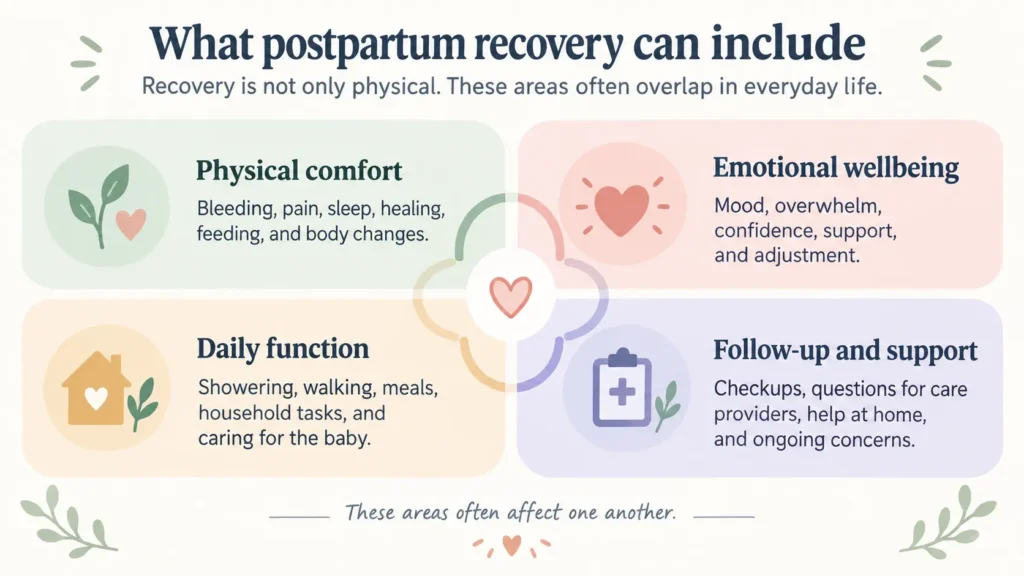
Postpartum recovery can involve bleeding and soreness, bowel or bladder changes, fatigue, emotional adjustment and the practical work of caring for yourself within a family. Those parts do not necessarily move together. Having fewer symptoms in one area does not answer every question about another.
This guide uses Months 1 through 6 to organize practical questions. The month labels are not biological stages or recovery deadlines. A symptom or support need may arise earlier, later, last longer or not occur at all. Use any section when it becomes relevant; you do not need to wait for its month.
Start with the safety guidance below if you have symptoms now. The rest of the guide explains recovery domains, ongoing care and ways to make ordinary days more manageable, across different births and family circumstances.
When to get help after birth
Emergency / urgent action
Call 911 or your local emergency number for chest pain, gasping or difficulty breathing, seizures, severe lower-abdominal pain, or thoughts of hurting yourself or your baby. Seek emergency help right away for leg pain, swelling or tenderness. ACOG’s postpartum guidance identifies these as reasons for emergency help .
Other CDC urgent maternal warning signs need medical care immediately, including:
- Heavy bleeding that soaks one or more pads in an hour, clots larger than an egg, passing tissue, or foul-smelling vaginal discharge.
- A temperature of 100.4°F (38°C) or higher.
- A severe headache, one that persists or worsens, or changes in vision.
- Sudden marked weakness or overwhelming tiredness that makes functioning difficult.
These are examples, not thresholds to wait to reach. Contact your medical team immediately; if you cannot reach them promptly, seek urgent assessment rather than waiting for a callback. Call emergency services if your condition is rapidly deteriorating.
New severe confusion, hallucinations or markedly altered beliefs need urgent same-day assessment. The NHS describes postpartum psychosis as a medical emergency . If there is immediate danger, call emergency services. A family member or friend may need to obtain help.
Contact a healthcare professional / prompt assessment
Without the urgent features above, contact your clinician about continuing discomfort, bladder or bowel difficulties, pelvic pressure, leakage, or mood and coping concerns. Increasing wound pain, redness, swelling or discharge needs advice right away, even without fever; NHS cesarean guidance explains these wound warnings .
You do not need every symptom, a particular month or a diagnosis before asking for help. Tell the team when you gave birth and what has changed. This list is not exhaustive, and a previous reassuring checkup is not a reason to ignore a new concern.
What postpartum recovery can include
Physical recovery and daily function
Physical recovery includes both symptoms and what those symptoms mean for your day. Soreness when sitting, difficulty getting comfortable in bed or trouble using the bathroom can matter just as much to you as a wound’s appearance. The question is not only whether something looks healed, but whether you are comfortable and able to do the things you need to do.
ACOG describes a range of postpartum symptoms, including vaginal bleeding, cramping, perineal pain (in the area between the vagina and anus), incision pain, and bladder or bowel problems. Their type, intensity and duration vary. You may have some of these concerns and not others; they are not a list every recovery must pass through.
Your birth provides context for care. If you had a tear or stitches, perineal discomfort may need attention. After a cesarean, incision care and advice about movement may be part of your discharge plan. Neither description covers the whole person. Fatigue, emotional wellbeing, meals and practical support still belong in the conversation, whatever the birth mode.
It can help to separate different questions. Is the discomfort improving? Can you move comfortably? Are you able to eat and get rest opportunities? Is something making ordinary tasks difficult? These questions help describe your experience; they are not a recovery score, and a reassuring answer to one does not cancel a concern about another.
For example, getting dressed might be easier while sitting through a meal remains uncomfortable. That is useful information to share. You do not have to describe the entire recovery as either good or bad, or wait until every part feels difficult before mentioning the part that does.
Recovery is also more than appearance. An incision looking healed does not establish that pain, bladder function, energy and emotional health have all been assessed. Looking “back to normal” is not a clinical measure of how someone feels or functions.
Emotional adjustment and personal experience
Emotional adjustment deserves space alongside physical recovery. You may enjoy parts of life with your baby while missing familiar routines, privacy or time that was your own. Those experiences do not have to fit one tidy account of how parenthood feels.
There is also a difference between allowing mixed feelings and dismissing distress. Persistent low mood, loss of enjoyment, anxiety or difficulty coping deserves professional attention. NHS guidance on postnatal depression explains symptoms and ways to get help. A difficult feeling does not automatically establish a diagnosis, but you do not need to diagnose yourself before talking to someone.
I gave birth to all four of my children by C-section. One important thing I learned was that recovery was not identical, even in the same body. Some recoveries were smoother. Others were harder. Some scars healed quickly; others stayed sensitive for months. Energy levels varied. Emotional recovery varied. That is my experience of different recoveries, not a timetable for someone else’s body or evidence that each birth must be harder than the last.
Having done it before did not make it easy. It only made it familiar.
For the more specific context of another cesarean, see recovery after multiple C-sections .
A broad postpartum recovery guide can help you identify questions, but it cannot determine what a particular symptom means. Keep your own care instructions and concerns at the center, rather than borrowing someone else’s explanation because their story sounds familiar.
Postpartum care is more than one checkup
Make the follow-up plan clear
A six-week visit is not a certificate of complete recovery. It also should not be the first opportunity you expect to have for discussing a problem.
ACOG recommends postpartum care as an ongoing, individualized process. Its US framework recommends contact with an obstetric care provider within the first three weeks after birth, followed by care as needed and a comprehensive visit no later than twelve weeks. These are points in a care framework, not biological deadlines or instructions to wait with symptoms. Your circumstances may require earlier or additional assessment.
Before leaving an appointment, try to establish what happens next. Is another visit already booked? Does someone need to arrange a referral? Who will explain a result? If you are unsure which clinician is responsible for a concern, ask the team to clarify rather than assuming someone else is following it.
This matters when care involves more than one service. You might have a maternity follow-up, a primary care appointment and another referral to organize. A short note with the next step and contact details can be more useful than trying to remember every conversation. It does not need to become a recovery binder.
If getting to an appointment is difficult, say what the obstacle is. Childcare, transport, work and cost are practical constraints, not evidence that you do not care about your health. Ask what arrangements are available, while keeping urgent symptoms separate from appointments that can be planned ahead.
Bring the concerns affecting your day
Follow-up should make room for your experience at home. A wound check cannot answer a question you have not had the chance to raise about leakage, sleep or mood. You can begin with the concern that most affects your day rather than trying to present everything in medical language.
Useful questions include:
Questions to bring to a postpartum follow-up
- Pain or bleeding: Does this pattern need assessment, and what changes should prompt earlier contact?
- Bladder, bowel or pelvic symptoms: What might need checking, and is a referral appropriate?
- Mood, sleep and fatigue: How can we assess what is making daily life difficult?
- Activity: What guidance applies to the tasks or exercise I want to resume?
- Other care: Can we discuss feeding-related discomfort, contraception or future pregnancy questions that are relevant to me?
These questions reflect the broad areas included in postpartum care; they are not a list of tests everyone needs. There is no requirement to discuss every topic in equal depth if one issue needs attention now.
If you leave without understanding the plan, it is reasonable to ask again. Knowing whom to contact between appointments is part of making care usable, especially when a new concern appears after the visit.
You can also use the Free Postpartum Recovery Check-In & Support Planner to keep questions, appointments, and everyday support needs in one place.
Postpartum Recovery: A Practical Month-by-Month Focus
These months are practical prompts, not medical stages, appointment dates or recovery deadlines. Use the questions whenever they are useful; none belongs only to its listed month.
| Period | Practical focus | Questions to revisit |
|---|---|---|
| Month 1 | Daily care and immediate support | Who can cover meals, chores and appointment logistics? |
| Month 2 | Care plan and workload | What follow-up remains, and has available help changed? |
| Month 3 | Energy and emotional wellbeing | What is difficult enough to discuss with the care team? |
| Month 4 | Comfort and daily function | Which everyday demands need adjustment or assessment? |
| Month 5 | Individual activity goals | What guidance fits the activities I want to resume? |
| Month 6 | Continuing support and care | Who will follow concerns that remain or arise? |
Month 1: Make daily recovery manageable
Make room for care and rest
Early daily life can contain competing needs: your own care, a baby’s needs, something to eat and a household that has not stopped producing laundry. A manageable routine starts with the tasks that actually need doing, then asks which ones need to be done by you.
Keep your discharge instructions accessible. If an instruction is unclear, ask the team rather than turning it into a stricter rule just to be safe. Advice about movement, pain management and follow-up should relate to the birth and care you received. Someone else’s restrictions may not be yours.
For the practical side, think about the next part of the day rather than designing a perfect routine. Is there food you can eat without preparing a full meal? Is someone available to deal with the dishes afterward? Can a necessary errand be combined with a trip another person is already making?
If you have older children, separate their needs into concrete arrangements. A school pickup, packed lunch or bedtime handover is easier to assign than “help with the children.” The person making dinner may not be the person who can manage pickup. Naming both tasks prevents one generous offer from being mistaken for a complete plan.
Visits can be welcome without becoming hosting commitments. You might want company but not a long stay, or food dropped at the door without a visit. You can make that distinction in advance. There is no need to tidy the house to justify accepting help with it.
Rest opportunities need similar practical support. Someone taking over a task is more concrete than being told to rest whenever possible. Depending on the day, a break might mean lying down, sitting comfortably with a meal or letting someone else handle the next household decision.
Rest does not mean complete inactivity. NHS cesarean recovery guidance encourages mobility without overexertion, and your care team can explain what that means for you. Do not use a rest plan to replace advised movement, or a movement goal to override symptoms.
When help is limited, a smaller day may be the available option: an easy meal, fewer optional errands and one request someone can realistically accept. That is a way of organizing the workload, not a promise that enough rest will resolve every recovery concern.
Describe symptoms rather than guessing their cause
Bleeding after birth, called lochia, is one part of physical recovery. The NHS explains that it generally decreases over several weeks. Bleeding can also occur after a C-section. Heavy bleeding or other warning features described above need immediate care; the fact that some bleeding is expected does not establish that your particular bleeding is safe.
If you are concerned, describe the amount, whether it has changed and what else you have noticed. You do not need to decide whether it is “normal lochia” before contacting the team. Avoid using someone else’s stopping date as a deadline for yours.
Soreness can also need a more specific conversation. Where is it? Is sitting, standing or using the bathroom difficult? Is the discomfort continuing or becoming worse? Perineal and incision concerns belong with the team that can assess them, rather than being explained away by the number of days since birth.
Bowel and bladder changes can be awkward to mention, but they are relevant to care. The NHS advises seeking advice for difficulty urinating, continuing constipation or bowel leakage. Describe the problem plainly. “I am having trouble emptying my bladder” gives the team something concrete to assess; you do not need a technical term.
Follow your individual care instructions and ask if they are not helping with the concern you have. This guide cannot tell you how to treat a wound or choose a medication. What it can help with is making the problem visible instead of quietly rearranging every part of the day around it.
Month 2: Revisit your care and support plan
A plan that worked when someone was staying with you may need changing when that person leaves. Another adult might return to work, meal deliveries might stop, or you may still have the same help. None of these changes belongs to a fixed postpartum month. This is simply a useful point to check whether available support matches the work.
Look at what changed rather than assuming the original arrangement still covers it. If mornings are now yours alone, who prepares anything needed before leaving? If the person who drove you to appointments is unavailable, what is the alternative? A plan can fail because one small piece disappeared, even when everyone still means to help.
It may be useful to distinguish temporary gaps from responsibilities that need a new owner. A single appointment might need one favor. Shopping, school pickup or evening meals may need an ongoing arrangement. Asking for the actual task makes it easier to see whether the offer matches the need.
The care plan may need attention too. Check whether a recommended appointment or referral has been arranged, especially if you were waiting to hear from someone. You do not need to repeat every question from the first visit, but you can explain what has changed since then. If an earlier concern remains troublesome, say so rather than assuming that having mentioned it once means follow-up is underway.
Bladder and pelvic-floor symptoms are examples of concerns that can get absorbed into daily life. You might start choosing clothes around leakage or avoiding an activity because of pressure. Those adjustments may make a day easier, but they do not tell you what is causing the symptom.
NHS advice on bladder changes after birth includes discussing symptoms and possible further help. Pressure, heaviness or pain with intimacy also deserves assessment. These appear among symptoms for which the NHS advises evaluation, but having them does not establish prolapse or mean that weak muscles are the explanation. Treatment depends on what is found.
You can explain the effect without minimizing it: “I avoid walking to the store because of the pressure,” or “I am leaking when I cough.” These are examples of how to describe a concern, not questions you must answer in a particular way. There is no need to wait for symptoms to become severe or for another month to arrive.
For this part of recovery, the practical question is whether a need has been left without a plan. That might be a household job nobody has taken over, or a symptom that still needs professional attention. They need different responses, even when both are making the same day difficult.
Month 3: Check how you are feeling and functioning
“Why am I still not better?” can mean several different things. You might be frustrated by a symptom, exhausted by the daily workload, worried about your mood or comparing today with what you expected before birth. Separating those concerns gives you a clearer starting point than deciding that the whole recovery is going badly.
Try describing a few ordinary parts of the day. Perhaps getting out of the house is easier, but preparing a meal still feels unmanageable. Perhaps you are more confident with practical care but find little enjoyment in things you usually like. Progress in one area can be real while another concern still needs attention.
This is not an invitation to monitor yourself constantly. A short description may be enough: what feels difficult, when you notice it and how it affects what you can do. You do not need to create a detailed record before asking for help, and urgent changes should not wait while you gather information.
Fatigue deserves more than a quick explanation that everyone with a baby is tired. Sleep and fatigue are part of ACOG’s recommended postpartum assessment. Tell your clinician if tiredness is persistent, troubling or interfering with daily life. They can consider it alongside your other symptoms and circumstances rather than assuming one cause.
Sudden marked weakness or overwhelming tiredness belongs to the urgent guidance at the beginning of this article. It should not be treated as a predictable third-month crash. You do not have to decide whether tiredness is medical or practical before you report it.
Emotional wellbeing also needs its own attention. The NHS describes postnatal depression symptoms that can include low mood, loss of enjoyment, anxiety, hopelessness and difficulty coping. These are reasons to talk with a professional, not a list from which to diagnose yourself. Persistent distress should not be explained as the price of parenthood.
If telling someone feels difficult, begin with what the day is like. You can say that you are struggling even if you cannot explain why. A trusted person may help you make contact or accompany you, but practical support and professional assessment do different jobs. Having someone cook dinner does not settle a concern about your mood.
Expectations can be revised at home as well. Instead of assuming that elapsed time means you can take back every responsibility, discuss what is actually manageable now. One useful conversation might be about keeping a task shared, rather than proving you can do it alone. The aim is to respond to the current situation, not to meet an imagined version of Month 3.
Month 4: Match daily expectations to your needs
Looking well is not the same as feeling or functioning well. Someone may see you dressed and out of the house without seeing the planning that made the trip possible, the task you left undone or the discomfort you are trying to accommodate.
That does not make appearance a problem to solve. You do not need to look unwell to describe a concern. The more useful question is what a particular demand involves and whether it fits your current needs.
Consider an ordinary grocery trip. It may involve getting everyone ready, traveling, walking around the store, handling bags and putting everything away. “Going shopping” sounds like one task, but the difficult part might be only one piece. If someone can handle that piece, the arrangement may become more manageable. If pain is the obstacle, adjusting the errand does not replace discussing the pain.
The same applies to meals or childcare. Standing to cook may feel different from sitting to help with homework. A social visit may be enjoyable while hosting it at home feels like too much work. You can distinguish the activity you want from the extra demands attached to it.
Try making requests around that distinction. You might welcome a visit if someone else brings the food, or attend a gathering without contributing a dish. These are practical options, not rules for protecting recovery. They also leave room for your preferences: wanting company and wanting fewer obligations are not contradictory.
Continuing pain or pressure deserves assessment, even if you have become good at working around it. ACOG advises contact for pain that persists or worsens after a tear or incision. The fact that you can complete a task does not necessarily describe how uncomfortable it was. Explain both.
Some expectations may be your own. You might miss being spontaneous or doing an errand without calculating who needs to be where. There is room to acknowledge that without deciding it reveals a permanent change in who you are. Nor does Month 4 require a particular emotional response.
A useful adjustment is specific: divide an errand, change who prepares dinner, or discuss a symptom you have been accommodating. “Expect less of yourself” is vague. Identifying which demand is difficult gives you and anyone helping a clearer place to act, without treating every challenge as something you should simply accept.
Month 5: Revisit activity and personal goals
Let your recovery guide progression
Month 5 is not an exercise start date. Some readers resumed activity much earlier; others may need further individualized guidance. This section is a place to revisit the activities you want in your life, whenever that question becomes relevant.
ACOG’s guidance on exercise after pregnancy supports gradual return and advises asking your obstetric clinician about starting again after a cesarean or complications. Your birth, symptoms and clinical advice matter more than where an activity appears in a month-by-month guide.
Be specific about what you want to do. “Can I exercise?” may not capture whether you mean a walk, a class or a return to an activity you did regularly before pregnancy. Explaining the goal gives your clinician a clearer question to answer. You can also ask what would mean the plan needs reassessment.
Stop exercise that causes pain, as ACOG advises. Pressure or leakage can also deserve professional assessment; they should not become symptoms you repeatedly work around by reducing activity without ever asking about them. The appropriate response depends on the symptom, with urgent changes following the safety guidance above.
This is not a workout plan. It does not establish a lifting limit, an order of exercises or a week when everybody should progress. A focused conversation about return to exercise after birth can take account of details that a general recovery guide cannot.
Make goals fit the rest of the day
Wanting an activity back does not automatically create time for it. If doing it means you still need to complete every errand afterward, the practical plan may need as much attention as the activity itself.
Think about what the goal requires around its edges. Is someone available for childcare? Does getting there involve travel? Would the arrangement leave you rushing to prepare dinner immediately afterward? These questions do not decide medical readiness; they help you see whether the plan fits ordinary life.
A goal might also be unrelated to exercise. You may want a quiet hour with a book, time with a friend or an uninterrupted meal. You do not have to choose the activity that looks most like progress to other people.
Where someone can help, ask for the whole period you need rather than just the activity’s advertised length. A class may be an hour, but getting there and back also takes time. If that is not workable, a different plan is an option, not evidence that you lack commitment.
Keep your own reasons visible. Wanting to feel comfortable doing something you enjoy is a useful starting point. It does not require comparison with another parent’s schedule or turning every available break into another task to complete.
Month 6: Keep the support and care you still need
The end of this six-month guide is a point to review arrangements, not a declaration that recovery is complete. Some areas may feel significantly better. Others may still need attention. If you feel well, you do not need to search for a problem to justify the idea that recovery varies.
Look at what you would like to keep. Perhaps sharing meal planning has worked well, or a regular arrangement with a friend makes appointments possible. A useful arrangement does not have to end simply because it began after birth. You can decide whether it still fits the family rather than treating it as temporary help with an automatic expiry date.
Other arrangements may need changing. An appointment series might be ending while a separate concern remains unresolved. Check who will follow that concern and how to contact them. ACOG’s postpartum-care guidance includes transition to ongoing care, rather than treating one comprehensive visit as the end of attention to your health.
If a symptom has become familiar, consider whether you have received an explanation and a plan, or have simply learned to avoid what makes it noticeable. Those are different situations. You can return to the conversation if the original advice has not addressed the problem or your circumstances have changed.
This does not mean that every ongoing difficulty proves damage or that every change needs treatment. It means an article cannot decide what is permanent, what needs assessment or what care is appropriate for you. Describing your concern is more useful than deciding you have missed a recovery deadline.
It can help to separate what you want to ask a professional from what you want to change at home. A question about persistent discomfort belongs in care. A question about who manages the shopping may need a household conversation. Both can matter without being the same kind of problem.
There is no required feeling of acceptance at six months, either. You may feel settled, uncertain, pleased with some changes or frustrated by others. Ongoing emotional concerns deserve the same attention they would have earlier.
Use this point to keep the next step clear: who is responsible for any continuing care, what support remains useful and what you want to revisit. The calendar can help you remember to check in. It cannot tell you that your body or your questions are finished.
Practical support that fits family life
Meals that do not become another project
Food help is most useful when it leaves you with something you can actually eat. A bag of ingredients can be generous, but it may still leave planning, cooking and cleanup to you. It is reasonable to ask for a ready-to-eat meal or something that only needs reheating if that is what would help.
Simple options from everyday meals include:
- Eggs with toast and fruit.
- Yogurt with nuts and berries.
- Soup with beans and bread.
- Chicken with rice and vegetables.
These are possibilities, not a postpartum diet formula. Choose foods that fit your preferences, dietary needs and budget. There is no special combination here that promises to fix energy, change hormones or accelerate healing.
When someone offers food, a little practical detail can prevent more work. Let them know about dietary needs, whether there is freezer space and whether you have a container to return. A meal that requires tracking down dishes afterward may be less convenient than one portioned into a container you can keep.
You can also make the request smaller. Someone already shopping might add a few familiar items to their trip. A friend cooking for their own household might bring an extra portion. Help does not have to take the form of an organized meal schedule to be useful.
If nobody is bringing food, consider what is easiest to repeat without much preparation. Frozen vegetables, leftovers or a familiar ready-made option can be part of that decision. The practical aim is fewer steps between needing a meal and having one, not a new standard of home cooking.
Share the work and protect rest opportunities
“Tell me what to do” can be a sincere offer and still leave you in charge of noticing, planning and checking every task. Taking responsibility for a whole job is different. The person handling groceries can check what is needed, shop and put things away, instead of waiting for instructions at every stage.

Choose a task with clear boundaries. Older-child pickup includes knowing the time and arrangements. Making dinner includes deciding what to make and dealing with the preparation. Attending an appointment may require another person to cover the period around travel, not only the appointment itself.
You might phrase a request like this: “Could you handle dinner from deciding what to make through cleanup?” Or: “Can you cover pickup on the day of my appointment?” These are examples of direct requests, not scripts that every family must use. Adapt them to the person and the help available.
Visitors and helpers can overlap, but a visit is not automatically practical support. You may want someone to sit and talk, someone to take over a task or simply less company that day. Saying which would help avoids expecting a guest to guess, while also making clear that you are not offering to host.
When possible, connect a rest opportunity to a task someone has taken over. Otherwise, a break can end as soon as you remember something nobody is handling. That is about sharing responsibilities, not a physiological claim about what a particular amount of rest will do.
Not everyone has a partner, paid help, leave from work or nearby family. Advice that assumes an available adult for every difficult moment is not useful to everyone. A smaller request may be more realistic: collecting a prescription, adding groceries to an existing trip or accompanying you to one appointment.
Tell the care team if practical barriers are affecting access to care and ask what local support or appointment arrangements are available. There may not be a simple solution, and asking does not guarantee a service. It does make the obstacle visible rather than leaving you to quietly miss care. Urgent symptoms still require urgent action.
You do not need a perfect support network before making one responsibility more manageable. Start with the task that is causing the most difficulty and the help that is actually available, rather than building a system you then have to manage yourself.
Frequently asked questions
How long does postpartum recovery take?
There is no single completion date that covers pain, daily function, energy and emotional wellbeing for everyone. ACOG notes that postpartum symptoms vary in type, intensity and duration. A general six-month guide cannot turn those differences into one expected recovery time.
It is more useful to identify the part you mean. Are you asking about discomfort, an activity you want to resume or a concern about mood? A clinician can discuss that specific issue with you. A routine visit is not proof that every aspect is complete, and a symptom should not be dismissed because another person experienced it too. Equally, you do not need to feel unwell for a prescribed period to have had a legitimate recovery.
When should I discuss ongoing fatigue with a clinician?
Discuss fatigue when it concerns you, persists or interferes with daily life. You do not need to wait until it has lasted a certain number of months. Describe what you are finding difficult and any other changes you have noticed, rather than assuming sleep loss explains everything.
Sudden marked weakness or overwhelming tiredness can require immediate medical care, as described in the CDC maternal warning signs. Use the early safety guidance for urgent changes instead of waiting for a routine appointment. For an ongoing concern, the next useful step is assessment, not trying to decide for yourself which condition might be responsible or which test to request.
Is it okay to miss parts of my life before birth?
Yes. Missing privacy, familiar routines or time with friends does not mean you have to explain away your affection for your baby. You can value what has changed and miss something that mattered before. There is no required balance of gratitude and difficulty.
However, persistent low mood, loss of enjoyment, anxiety or trouble coping deserves help, not a reminder to appreciate what you have. NHS postnatal depression guidance explains when to seek support. You can talk about how you feel without arriving with a diagnosis. An ordinary wish for time to yourself and a concern that you are struggling may need different kinds of support; both are worth expressing honestly.
What You Need to Know
- Postpartum recovery includes different physical, emotional and practical concerns; they do not all progress together.
- Months are navigation prompts, not biological stages or recovery deadlines.
- Postpartum care is ongoing and should respond to your individual needs.
- Practical support works best when it addresses the tasks and circumstances you actually face.
- Concerning symptoms deserve assessment, regardless of the month or a previous checkup.
If symptoms are urgent, seek care now. Otherwise, choose one concern to discuss with your care team and one responsibility that could be shared or made more manageable. You do not need to solve the whole next month today.
Want something practical to use after reading? Download the Free Postpartum Recovery Check-In & Support Planner to organize questions, appointments, support, and day-to-day recovery.