


Some stress during pregnancy is normal, and one difficult day is not evidence that you have harmed your baby. Persistent distress deserves support, especially when it affects sleep, eating or everyday life. Research linking stress with pregnancy outcomes is more complicated than “stress harms the baby”: the type of stress, when it happens and other circumstances all matter. NHS guidance on anxiety in pregnancy and MotherToBaby’s stress guidance help put those concerns in context.
That can be difficult to hold onto when advice keeps returning to “try to relax.” You may already know you need a break. Finding one, paying the bills or getting through a worrying appointment can be the harder part.
The useful questions are more specific: what is weighing on you, how much room is it taking up in your life, and what kind of help would make a difference? Understanding the evidence can help you ask those questions without turning every emotion into something else to monitor.
Is stress during pregnancy normal?
Yes. Pregnancy brings changes and uncertainty, and some stress is expected. Worry about appointments, work, money or becoming a parent is something you can discuss during prenatal care. NICHD’s pregnancy-stress guidance explicitly encourages those conversations.
You do not have to feel happy about every part of pregnancy. You might be pleased about the pregnancy and exhausted by the practical demands. You might have mixed feelings that are difficult to explain. There is room to talk about what is happening without first making it sound more positive.
Crying after an argument, feeling anxious before a scan, having a demanding workday or sleeping poorly for one night is not evidence that the pregnancy has been damaged. Research into ongoing distress or major life events cannot establish that an ordinary upsetting moment harmed an individual baby. Stress is difficult to separate from the other circumstances around it, as MotherToBaby explains.
It can help to be specific about the concern. “I cried yesterday and now I’m frightened” calls for a different conversation from “I’m overwhelmed most days and I can’t manage my usual tasks.” Both deserve a response, but the second also raises a practical question about support and assessment.
You can bring either concern to your appointment without deciding beforehand what your feelings mean.
What counts as persistent or severe stress?
There is no single definition that makes every study of stress during pregnancy comparable. Researchers may measure how overwhelmed someone feels, ask about events such as bereavement, or examine demands and control at work. Those approaches describe different parts of a person’s life. The distinction is visible in research on stressful life events and psychosocial work stress.
In everyday terms, persistent stress means the strain keeps returning or does not give you much room to recover. Think of ongoing financial uncertainty or a workload that stays unmanageable. These are examples to help describe your circumstances, not a diagnostic definition or a threshold for harm.
Some related experiences need their own names:
- Anxiety can involve worry that is intense, hard to control or disruptive to daily life. An anxiety disorder goes beyond temporary nervousness. ACOG: Anxiety and Pregnancy
- Depression can include persistent low mood, loss of interest, hopelessness or difficulty managing daily tasks. It can occur during pregnancy as well as after birth. NIMH: Perinatal Depression
- Major stressors and trauma describe experiences such as loss, violence or a disaster. PTSD is a condition that can develop after trauma; experiencing a distressing event does not automatically establish that diagnosis. NICHD: Stress and PTSD in pregnancy
These experiences can overlap. When you read about a study, check whether it examined ongoing symptoms, major events or a diagnosis: the word “stress” may be standing in for very different experiences.
“High stress” in a paper may simply mean a higher score on the questionnaire that particular study used. It does not supply a universal number of stressful days that becomes dangerous. Likewise, cortisol is a biological measurement, not a direct reading of how someone feels. A review of maternal cortisol research found substantial differences in measurement methods and results.
For your own care, describing the pattern is more useful than choosing the perfect label: when it started, what brings it on, whether there are breaks, and what has become harder to do.
How stress can affect your wellbeing
Getting help with stress during pregnancy can start with your own wellbeing. You do not need proof of an effect on the baby before your sleep, appetite or ability to get through the day matters.
Persistent worry can make it difficult to concentrate, relax or sleep. For example, you might have time to rest but find that your thoughts keep returning to the same fear. The NHS describes these difficulties as reasons to discuss anxiety during pregnancy.
It helps to explain the difference between an occasional disruption and a pattern. Perhaps you were awake before one appointment and slept better afterward. Or perhaps bedtime has become hours of worry every night. Those details tell your clinician more than “I’m probably just stressed.” You do not need to decide for yourself whether stress explains everything.
Blood-pressure research is less straightforward. A 2025 review of psychosocial work stress found mixed results across pregnancy-related blood-pressure disorders. Its preeclampsia finding depended on excluding a large study with methodological concerns. These occupational findings do not establish that getting upset causes preeclampsia.
An elevated blood-pressure reading needs assessment through prenatal care. Relaxation is not a substitute for that assessment, and a physical concern should not be dismissed simply because you also feel anxious. ACOG explains how high readings are assessed.
When preparing for a conversation, choose two or three concrete examples. “I keep losing track of what I’m doing,” “I’m struggling to sit down for meals,” or “I’m spending the evening worrying about tomorrow” makes the burden easier to understand. These examples are prompts, not symptoms you must have. Start with whatever is actually happening for you.
Can stress during pregnancy affect your baby?
Some studies find associations between particular stress exposures and birth or developmental outcomes. They do not show that a particular emotion caused harm. Much of this research follows people through pregnancy rather than assigning an exposure, so other differences between families can influence the findings. Research comparing several approaches to causality shows why that matters.
“Associated with” means two things occurred together more often in the studied group. To understand whether one caused the other, researchers also have to consider differences in health, resources and family circumstances. Keep that distinction in mind across the outcomes below.
|
Question |
What evidence suggests |
What it does not establish |
|---|---|---|
|
Occasional stress |
Some stress is expected. NHS |
An upsetting day means harm occurred. |
|
Persistent/high stress |
Definitions and exposures vary. Work-stress review |
One universal danger threshold. |
|
Preterm birth/growth |
Life-event studies find modest associations. Review |
An individual prediction. |
|
Miscarriage |
Associations appear in some studies. Prospective study |
Stress caused a particular loss. |
|
Birth defects |
Stress alone is unlikely to increase risk. MotherToBaby |
A broad causal claim from specific findings. |
|
Child development |
Findings vary; family factors matter. Cohort study |
A child’s future is determined. |
Pregnancy duration and preterm birth
A 2021 review combining 31 cohort studies found that prenatal stressful life events were associated with a modestly higher likelihood of preterm birth. This was evidence about life-event exposures, not a test of whether feeling worried on a particular afternoon changes when labor will begin.
The pooled relative risk was 1.20, or a 20% relative increase. That does not mean an extra 20 out of every 100 pregnancies. To illustrate the arithmetic only, if a starting risk were 10%, a relative increase of 20% would make it 12%. That hypothetical starting risk is not an estimate for you.
The estimate depends on how stress was measured and who took part. Even a large study can leave important differences between participants unaccounted for.
A large Norwegian family-based analysis found that associations with birth timing became substantially weaker after accounting for factors shared within families. That challenges a straightforward causal explanation. It does not settle every question about every severe exposure, but it is a reason to resist treating a pooled association as a forecast for your pregnancy.
Birth weight and fetal growth
The same life-event review found modest associations with low birth weight and being small for gestational age. These are related outcomes, but they answer different questions: birth weight records size at birth, while small for gestational age compares size with how far along the pregnancy was.
That difference matters when reading a claim that stress “stunts growth.” A study reporting birth weight cannot automatically establish a specific problem with growth during pregnancy. Nor can a stress questionnaire tell you how your own baby is growing.
The Norwegian analysis also found that accounting for shared family factors weakened the birth-weight association. That is one reason researchers cannot simply read the association as an effect of stress itself.
If growth is something you are concerned about, ask your prenatal clinician what the information from your pregnancy shows. A headline about a group of pregnancies cannot answer that individual question.
Later learning, behavior and emotional development
Research has examined children’s learning, behavior, emotional difficulties and stress responses. A 2025 systematic review covering the first three years found a varied body of evidence, with differences in distress measures, developmental assessments and the factors studies accounted for.
Those differences change what a result can tell us. A parent-completed behavior questionnaire, a developmental task and a clinical diagnosis are not interchangeable. A small average difference in a score also cannot describe the future of an individual child.
Genetics, socioeconomic circumstances and life after birth complicate the picture. In the Norwegian family-based study, accounting for shared family factors substantially weakened associations with emotional and behavioral difficulties too. If the same parent reports both prenatal distress and later behavior, reporting may influence the result. Missing follow-up data and selective publication of interesting findings are further concerns when interpreting this literature. The developmental review discusses substantial methodological limitations; these concerns do not show that every finding is wrong.
Studies measuring children’s cortisol responses answer another narrow question about physiology. A hormone difference does not, on its own, establish a lasting developmental problem. The maternal cortisol review found that strong conclusions were premature because results and methods varied.
This research can guide further investigation. It cannot tell a pregnant person that a stressful period has fixed their child’s personality, learning ability or emotional future.
Can stress cause miscarriage?
The evidence does not establish that ordinary worry or a specific upsetting event caused an individual miscarriage. Some research does find associations with stress, so an honest answer also needs to acknowledge those findings and their limits. MotherToBaby cautions that separating stress from other influences is difficult.
An older review of eight observational studies found an association between psychological stress exposures and miscarriage. The studies used different definitions and designs. Some asked people to remember earlier stress after an outcome had occurred, which can affect recall. Other factors were not consistently accounted for. Those limitations prevent the review from establishing that stress itself caused the losses.
A newer prospective study published in 2026 adds an important timing distinction. PRESTO enrolled people trying to conceive in the United States and Canada. Perceived stress before conception was not appreciably associated with miscarriage. In early pregnancy, particularly weeks 5–8, some higher stress-score groups had higher miscarriage rates. The pattern was not a steady increase across every score group.
Collecting information prospectively strengthens the evidence, but it does not solve every problem. The researchers identified possible reverse causation: changes connected with a pregnancy that is already developing problems might affect how someone feels. In that situation, distress could follow the process leading to loss rather than cause it.
The analysis did not adjust for nausea and vomiting, which the researchers identified as possible confounding factors. Confounding means another factor influences the relationship being studied. Stress measurement also had limitations. The findings do not prove that reducing stress would prevent miscarriage or identify one difficult day as the cause of a loss.
This distinction matters if you are looking back through a pregnancy, trying to find an explanation. An argument, a work crisis or a day spent crying can be easy to remember. That memory is not evidence of causation, and the studies cannot turn it into one.
You can discuss both your worry about miscarriage and the stress you are experiencing with your clinician. Those conversations do not require you to accept blame, dismiss the research or pretend you feel reassured before you do. The useful task is to understand what is known about your pregnancy and what support you need now.
Can stress cause birth defects?
Stress alone is not considered likely to increase the chance of birth defects, according to MotherToBaby. That is the clinical context to keep in mind if you are worried about something upsetting that happened during pregnancy.
Some observational research reports associations with specific anomalies. For example, a review of studies on cleft lip and/or palate examined maternal stress around conception. It found an association, but also substantial differences between studies and problems with how stress was assessed.
In some studies, mothers were asked afterward to recall whether they had experienced stress. Remembering and reporting an exposure after learning about a baby’s condition can introduce bias. Other circumstances may also influence the findings. The review therefore cannot establish that ordinary stress causes clefts, much less that stress causes birth defects in general.
There is no need to turn this evidence into a list of things your baby might develop. It cannot answer that question for an individual pregnancy. If you have a specific concern, explain it during prenatal care, including what happened and what you are afraid it means. A clinician can discuss the relevant information without relying on a broad claim about stress.
What role do cortisol and the placenta play?
Cortisol is part of normal physiology, including the body’s response to stress. It is not a substance that should be eliminated during pregnancy. Measuring maternal cortisol also does not tell researchers exactly how stressed someone feels or establish what effect there has been on a child. A systematic review found that the evidence did not support a simple explanation through cortisol alone.
The placenta helps regulate exposure. One enzyme, called 11β-HSD2, converts cortisol into cortisone. Researchers have investigated whether psychological distress is associated with changes in the gene activity involved in that process. A 2024 review of human placental research examined those associations, but gene activity is not the same as directly measuring how well the enzyme works.
Scientists are also investigating other routes, including stress-response signaling and inflammation. The developmental review discusses these proposed mechanisms, but their plausibility does not establish that a particular emotion produced a particular pregnancy outcome.
For a closer look at research on stress-related hormones in amniotic fluid, see Can Pregnancy Stress Change Hormones in Amniotic Fluid? That article explains what those measurements can tell researchers and why a hormone finding is not, by itself, proof of harm.
What can help with stress during pregnancy?
Start with what is making life difficult and what support is available. You may need a practical change, someone to talk to, treatment for anxiety or depression, or a combination. ACOG’s guidance includes therapy, individually considered medication, community resources and support from other people.
The purpose is to help you feel and function better. You do not need to make a case about pregnancy risks before asking for help. Choose an option that fits the problem in front of you, and leave room to adjust it if it is not useful.
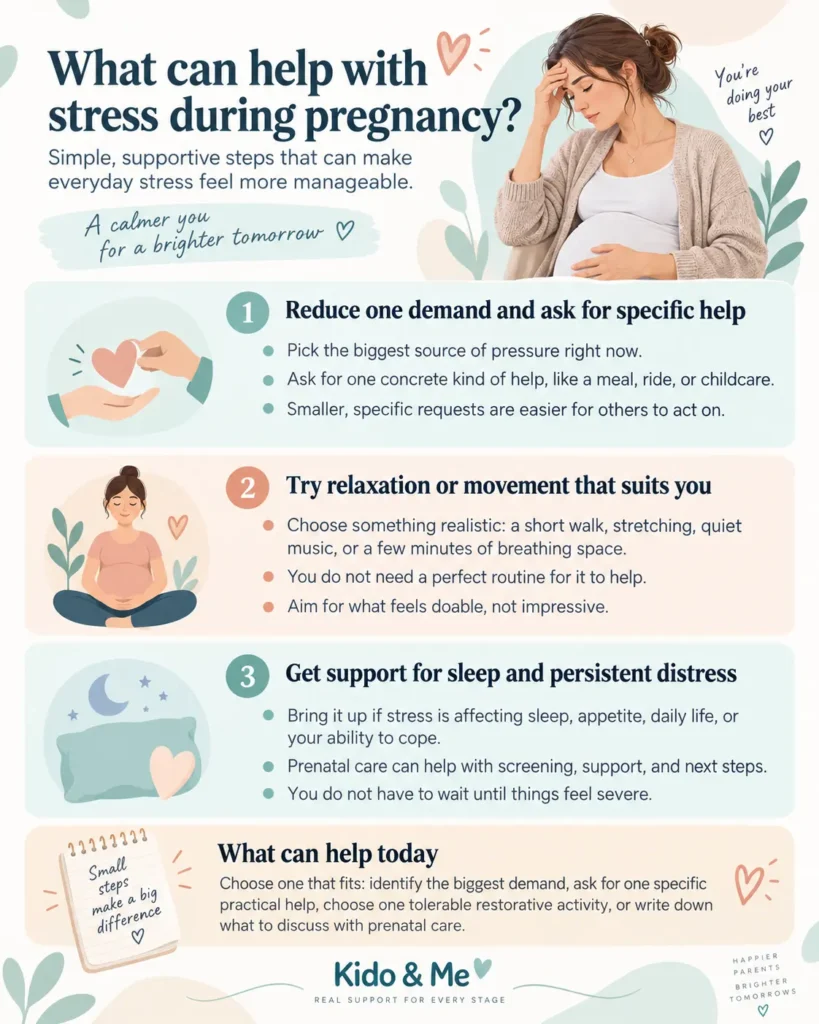
Reduce one demand and ask for specific help
Begin with a small question: which part of this week is hardest to carry? Perhaps it is getting another child to an appointment, keeping up with household tasks, or trying to finish work when several things are labeled urgent.
Choose something concrete enough that another person could take it on. For example:
- “Could you handle dinner and the dishes on Tuesday?”
- “Could you come with me to the appointment and take notes?”
- “Which of these work tasks needs to be finished first, and which can wait?”
These are suggested ways to ask, not a set of instructions everyone can use. A partner may be unavailable, family may live far away, and paid help may be out of reach. If personal support is limited, ask your prenatal team what community or social-work resources are available. Support groups and community resources are among the options in ACOG’s anxiety guidance.
You can also make the request smaller. Someone who cannot cover an afternoon might be able to collect a prescription or make a phone call. If you are the person coordinating every task, ask whether someone can take responsibility for the whole task, including remembering it.
Some stressors cannot be solved by reorganizing a week. Financial insecurity, difficult working conditions and unsafe relationships require support appropriate to the situation. You can tell your care team that practical circumstances are part of the problem, rather than accepting a plan that assumes you simply have more time to rest.
Try relaxation or movement that suits you
Relaxation approaches can help some people with symptoms of stress and anxiety. A 2024 review of relaxation interventions during pregnancy found benefits for maternal symptoms, while noting substantial differences between interventions and studies.
Options included breathing exercises, muscle relaxation, music and mindfulness approaches. You can choose something tolerable and easy to try. A few quiet minutes with music may fit your day better than a class. A brief guided exercise may be easier than deciding how to meditate on your own.
Notice whether the activity feels comfortable and useful. If it becomes another demand, try a different option or discuss what else might help. There is no reason to build your day around a routine you dread.
These approaches should not be sold as ways to prevent miscarriage or preterm birth. Many trials in the review were designed to examine maternal mental health rather than pregnancy complications. Feeling some relief is a worthwhile outcome without attaching a promise about the baby.
Movement is another option when medically appropriate. ACOG’s exercise guidance supports activity in a healthy, uncomplicated pregnancy and recommends discussing suitable activities with your prenatal clinician. Walking, swimming or appropriately modified activities may be possibilities, depending on your health and preferences.
Choose a starting point that works with your circumstances. You do not need a new subscription, a special outfit or an ambitious schedule to ask what kind of movement is suitable for you. If you have been given activity restrictions, use those instructions when considering your options.
Get support for sleep and persistent distress
Sleep deserves more than the instruction to “get plenty of it.” Consider what prevents it: lack of opportunity, discomfort, worry or a pattern you cannot readily explain. Describing that barrier helps make the conversation more useful than simply reporting that you are tired.
For ongoing insomnia, there are treatments beyond general sleep advice. A randomized trial of cognitive behavioral therapy for prenatal insomnia found greater improvement in insomnia severity than a comparison therapy. Participants had insomnia disorder; this was not a trial of an occasional bad night. CBT for insomnia is a structured treatment addressing sleep difficulties. Ask whether it is appropriate and accessible where you receive care.
Persistent anxiety may also benefit from talking therapy. The NHS describes CBT as a treatment option that can be delivered in person, online or by phone. For depression, evidence-based therapies include CBT and interpersonal therapy, which can address relationships and life changes. NIMH’s treatment overview explains these approaches.
Medication may be part of an individual treatment plan. Discuss the benefits, possible risks, previous treatment response and effects of leaving symptoms untreated with your clinician. ACOG advises against withholding or discontinuing mental-health medication solely because someone is pregnant or breastfeeding. Do not stop or change prescribed medication on your own because you have learned you are pregnant.
Access matters too. If a recommended appointment is unaffordable, difficult to reach or months away, say so. Ask what can happen while you wait and who will follow up. A plan needs to be workable in your actual week.
What can help today
Choose one that fits; you do not need to complete all four.
- Identify the biggest demand on you right now.
- Ask for one specific piece of practical help.
- Choose a tolerable restorative activity, such as quiet music or an appropriate walk.
- Write down what you want to discuss with prenatal care if distress persists or interferes with daily life.
When should you talk with your prenatal healthcare professional?
Bring it up when distress persists, worry feels difficult to control, or it interferes with sleep, eating, relationships, daily tasks or your ability to cope. You can also ask for support before things reach that point. You do not need to diagnose yourself or decide whether your situation is serious enough to deserve a conversation. NHS guidance focuses on how anxiety affects your life.
An opening sentence can be simple: “I’m finding stress during pregnancy harder to manage than I expected, and I’d like some help.” Follow it with what has changed. If you find it easier, write it down or show your clinician a note on your phone.
Useful details to bring include when the problem began, what tends to happen, how often it disrupts your day, and what support or treatment you have tried. Include any previous mental-health care and current medication. You can explain this in ordinary language; the assessment is your clinician’s job.
Screening questions may be part of the appointment. ACOG recommends screening for depression and anxiety at the initial prenatal visit, later in pregnancy and during postpartum care, using validated tools. A questionnaire helps begin assessment; it is not a grade for how well you are handling pregnancy.
Ask what the next step will be. That could involve further assessment, a therapy referral, a discussion about medication or practical support. ACOG’s treatment guidance includes treatment and referral, with follow-up to assess symptoms and response.
Before you leave, clarify who will contact whom. If you are waiting for a referral, ask when you should expect to hear, whom to call if you do not, and when your symptoms will be reviewed. You should leave knowing what happens next, even if treatment cannot begin immediately.
If you are at immediate risk of harming yourself or cannot stay safe, seek urgent local emergency help now. NHS guidance distinguishes immediate danger from routine mental-health support.
For the concerns that brought you here, a useful next step may be much smaller: save a question for your clinician, tell someone what this week has been like, or ask for help with the task that keeps being left to you. You do not need to solve every source of strain before that conversation can begin.
You do not have to feel calm all the time to take care of yourself during pregnancy. Start with what has become difficult, say what help you need, and make the next step something you can realistically do.