
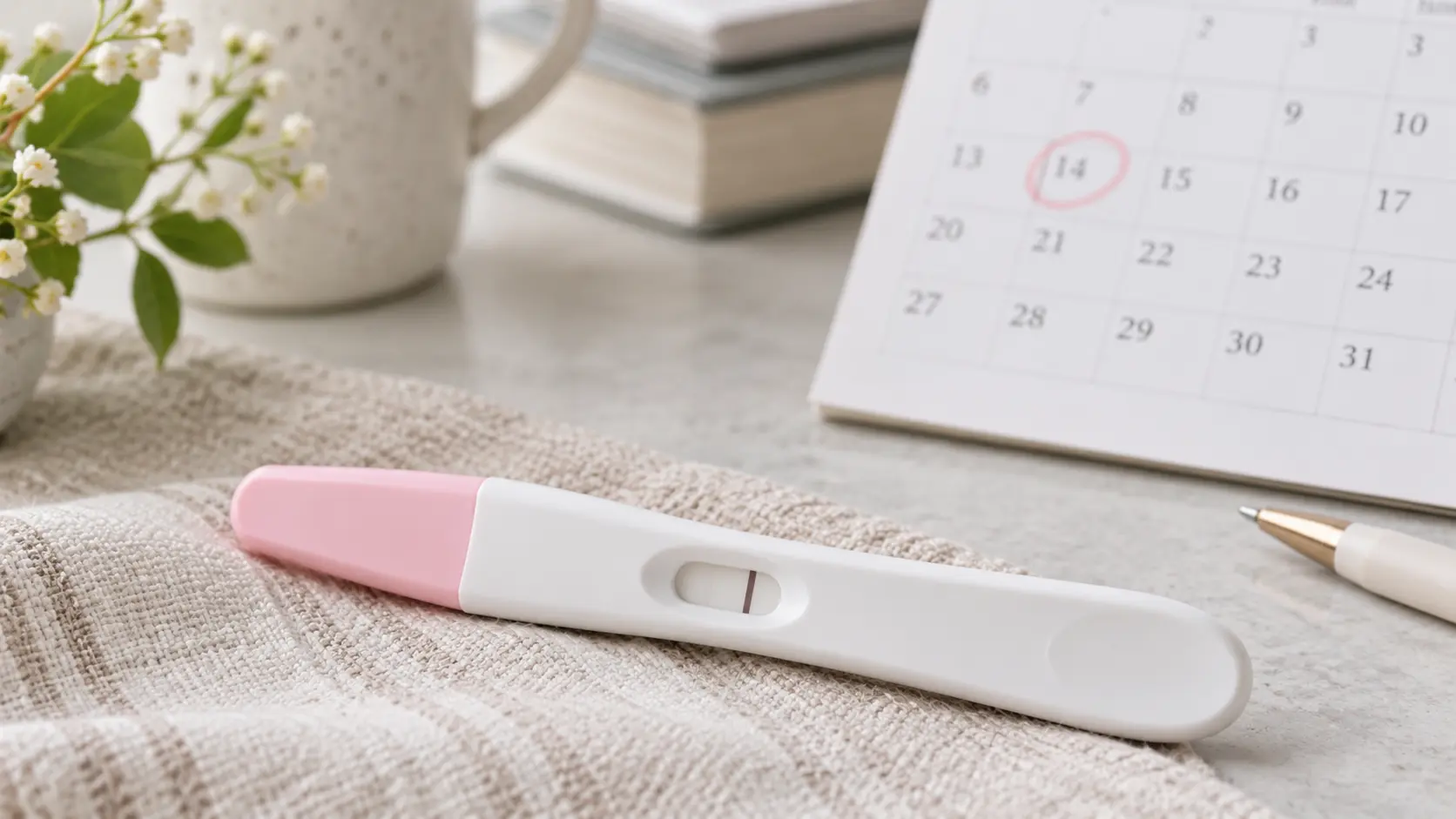
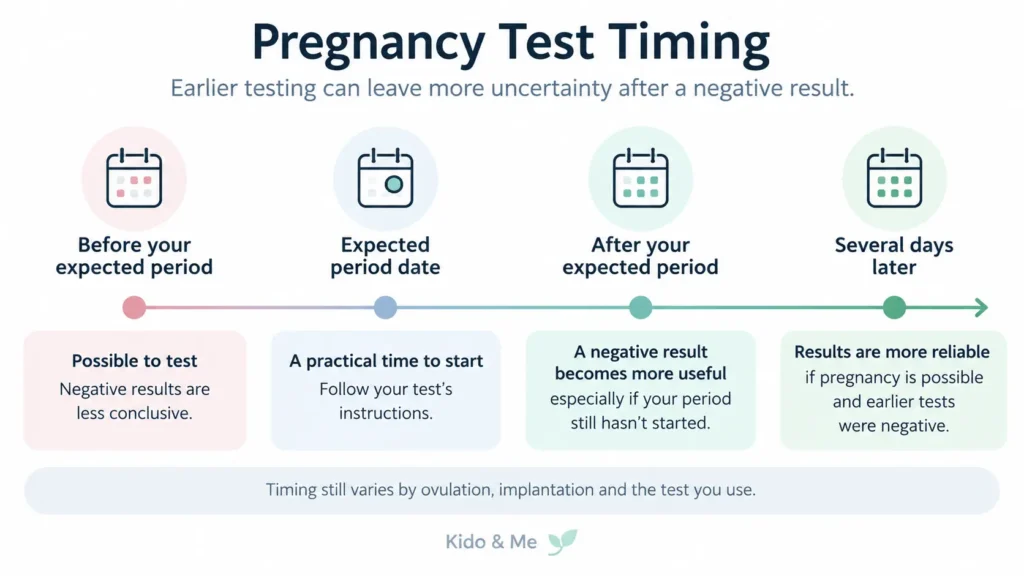
A home pregnancy test is generally most useful once your period is due or missed. Testing earlier can give a negative result simply because there isn’t enough pregnancy hormone for the test to detect yet. Follow the instructions for your particular test, including when to use it and when to read it. If you have concerning symptoms, such as severe abdominal pain, heavy bleeding or fainting, seek medical help instead of waiting for another home test.
When should you take a pregnancy test?
For most people, the first day of a missed period is a practical time to start. Some tests are designed for earlier use, but an early negative leaves more uncertainty.
Your expected period is the day you think bleeding should begin. Check how the test’s instructions count the days around it. “Before your missed period” and “before your expected period” can refer to different dates in a manufacturer’s wording.
The date on your calendar is also an estimate. Ovulation and implantation timing can vary, so the same testing date won’t work equally well for everyone, or even for every cycle.
If you don’t know when your period is due, NHS guidance recommends testing at least 21 days after the last time you had unprotected sex. That date doesn’t cover a more recent exposure. If your period remains absent or you’re unsure how the timing applies, contact a healthcare professional.
You may see advice to wait longer. The FDA describes testing one to two weeks after a missed period as most reliable. You can still reasonably start around your expected or missed period, following your test’s instructions. The distinction is between when to take a first test and how much confidence to place in a negative: an early negative is less conclusive and may need repeating.
Separate historical research helps explain the biology. In Wilcox and colleagues’ JAMA study, published in 2001, about 10% of the 136 clinical pregnancies with adequate data had not yet implanted by the day the next period was expected. The prospective data had been collected years earlier. Variation in ovulation and implantation timing creates a limit even for highly sensitive testing: a pregnancy cannot be detected before implantation and before hCG reaches detectable levels. This finding describes biological timing in that study, not a failure rate for today’s home tests or your personal chance of a false negative.
Before testing early, consider whether a negative would answer your question or simply leave you waiting to test again.
How do pregnancy tests work?
Pregnancy tests look for human chorionic gonadotropin, usually shortened to hCG. This hormone rises during early pregnancy and can be detected in urine or blood.
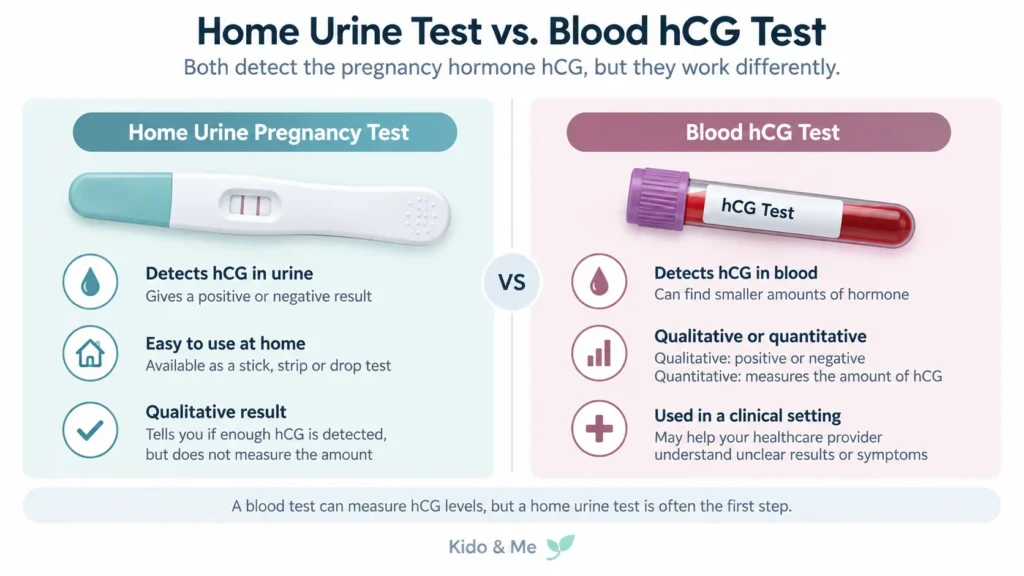
A home urine test gives a qualitative result: it tells you whether it found enough hCG to register a positive. It doesn’t measure the concentration for you.
That explains a common source of confusion. A negative result can mean there is no pregnancy, but it can also mean the sample contains too little hCG for that test to detect. Testing too early is one reason this happens.
A positive result usually indicates pregnancy. It doesn’t tell you where the pregnancy is developing or whether everything is progressing normally. Those are different questions, and a test stick cannot answer them by producing a clearer line or a digital word.
Home urine tests and blood tests: what is the difference?
Home tests use urine. Clinical blood tests use a blood sample, and some provide information that a home test cannot.
Home formats include sticks held in the urine stream, strips dipped into a collected sample, and devices that use drops of urine. The collection method depends on the test. Follow its directions rather than assuming all formats work the same way.
The result may appear as lines, a plus or minus symbol, or words on a digital display. A digital display removes the task of interpreting a faint line, but “digital” doesn’t tell you the device’s detection threshold. You still need its instructions.
What types of home pregnancy tests are there?
Home tests differ in how you collect urine and how you read the result. These features can overlap: a digital test may also come in a plastic stick.
- Midstream / stick tests: These are the familiar plastic sticks. Depending on the product, you hold the absorbent tip in your urine stream or dip it into collected urine. Results may appear as lines, symbols or words.
- Strip tests: These simple strips are usually dipped into urine collected in a container. Check the specified dipping depth and time, then read the line-based result within the stated window.
- Cassette / dropper tests: You collect urine separately, then use a dropper to put the specified number of drops into the cassette’s sample well. The result appears in its test window.
- Digital tests: These display words or symbols instead of requiring you to interpret a traditional line result. “Digital” describes the display; it doesn’t automatically mean greater sensitivity, better accuracy or earlier detection.
The format mainly tells you how to collect the sample and read the result. How early a test can detect pregnancy depends on the individual product’s sensitivity, which we’ll look at after the blood-test basics.
A clinician may also use a urine test. Having it done in an office doesn’t automatically mean it can detect a much earlier pregnancy than your home test; the FDA notes that their detection abilities can be similar.
There are two types of blood pregnancy tests:
- Qualitative blood testing reports whether hCG is detected.
- Quantitative blood testing measures the amount of hCG in the sample.
Blood testing can detect smaller amounts of hormone and may help your clinician make sense of unclear results or symptoms. You don’t automatically need a blood test after taking a home test.
If your clinician asks you to repeat a quantitative blood test, ask what they hope to learn from the results. Our guide to understanding blood hCG trends explains why those results need clinical context.
Pregnancy test sensitivity: what do 10 and 25 mIU/mL mean?
mIU/mL means milli-international units per milliliter. It describes a concentration of hormone in a sample, not the total amount in your body.
A stated sensitivity of 10 mIU/mL is a lower nominal detection threshold than 25 mIU/mL. Under the specified testing conditions, a test that reliably detects the lower concentration may identify hCG when a test requiring a higher concentration does not.
The distinction between analytical sensitivity and pregnancy detection matters here:
| Measure | What it describes | What it cannot promise |
|---|---|---|
| A stated 10 mIU/mL threshold | Detection of a lower hCG concentration under specified conditions | A fixed number of extra days of early detection |
| A stated 25 mIU/mL threshold | Detection at a higher nominal concentration | That the test will be unsuitable or inaccurate when used as directed |
| Real-world detection performance | How testing works for people at a particular point in pregnancy | The same result for every person on the same calendar day |
A lower detection threshold can detect a lower concentration of hCG — but it cannot promise you an earlier positive result.
The analytical detection threshold tells you how little hCG a test can detect under defined conditions. Clinical or real-world detection performance tells you how often testing picks up pregnancies in people at a particular time. The day you test, your urine’s concentration, natural variation in hCG, the test’s design and how you use it all play a part.
For a current product example, Clearblue states that its US Early Digital Pregnancy Test has a sensitivity of 10 mIU/mL. This is a manufacturer specification for that particular test. It isn’t independent proof that the product is best, that all digital tests share that threshold, or that it will detect your pregnancy a set number of days earlier.
A 2026 PRESTO study of home testing helps show why the distinction matters. Researchers analyzed 19,908 reported tests from 5,979 North American pregnancy planners who detected a pregnancy. Early-use sensitivity was lower than anticipated from laboratory performance claims.
The study relied on reported results and estimated missing daily tests. It included pregnancy planners who were not using fertility treatment, and it wasn’t a head-to-head brand comparison. Its findings help explain uncertainty around early negatives; they don’t supply a personal prediction or a shopping ranking.
How to use a home test and understand accuracy claims
Read the instructions before opening the test. Check the expiration date, how to collect the urine and how long the test’s absorbent tip or strip should stay in it. Find the exact time to read the result, and set a timer rather than estimating the wait.
First-morning urine can be useful when testing early, because concentration matters when there is little hCG to detect. But it isn’t a universal requirement for every test at every stage. For example, Clearblue Early Digital instructions specify first urine of the day before the expected period, while allowing testing at other times afterward.
Avoid drinking a large amount of fluid to make yourself urinate for the test. Dilution can make hCG harder to detect. Follow the instructions that came with your device rather than creating a special fluid-restriction routine.
Accuracy claims need the same attention as the practical directions. Look for the day tested and what the percentage actually describes.
For example, First Response reports that its Early Result test gave positive results in 76% of samples from pregnant women five days before their expected period. Its “over 99%” claim is tied to later timing and typical pregnancy hormone levels. Those statements describe different testing conditions.
The manufacturer also explains that six days before a missed period means five days before an expected period. Reading that small distinction can prevent a full day’s misunderstanding.
These examples explain labels; they don’t establish which product you should buy. A useful question is: “What does this claim mean for the day I plan to test?” A headline percentage without its timing cannot answer that.
What do positive, negative, faint and invalid results mean?
First check that the test worked and that you read it within its instructed window. Control indicators and result symbols vary, so keep the instructions beside you.
| Result | What it may mean | What to do next |
|---|---|---|
| Valid positive | hCG was detected; pregnancy is likely | Contact a healthcare professional to discuss care and next steps |
| Negative | No pregnancy, or too little hCG detected at that time | Check timing and instructions; repeat if appropriate |
| Faint positive line within the valid window | A positive if it matches the test’s specified pattern and the control is valid | Follow the positive-result instructions; seek help if you cannot interpret it |
| Invalid, error or missing required control | The test has not produced a usable result | Replace it and follow the directions for a new test |
| Result checked outside the reading window | Late changes may be misleading | Don’t reinterpret a dried test; use a new one as directed |
| Positive followed by negative, or conflicting results | More than one explanation is possible | Contact a clinician; symptoms may require urgent assessment |
For line tests, the relevant question is whether the result meets the instructions, not whether the line looks as dark as a photograph online. For example, Clearblue Rapid Detection instructions accept a lighter line within the specified positive symbol, with a valid control and correct reading time. That doesn’t make every shadow on every test a positive.
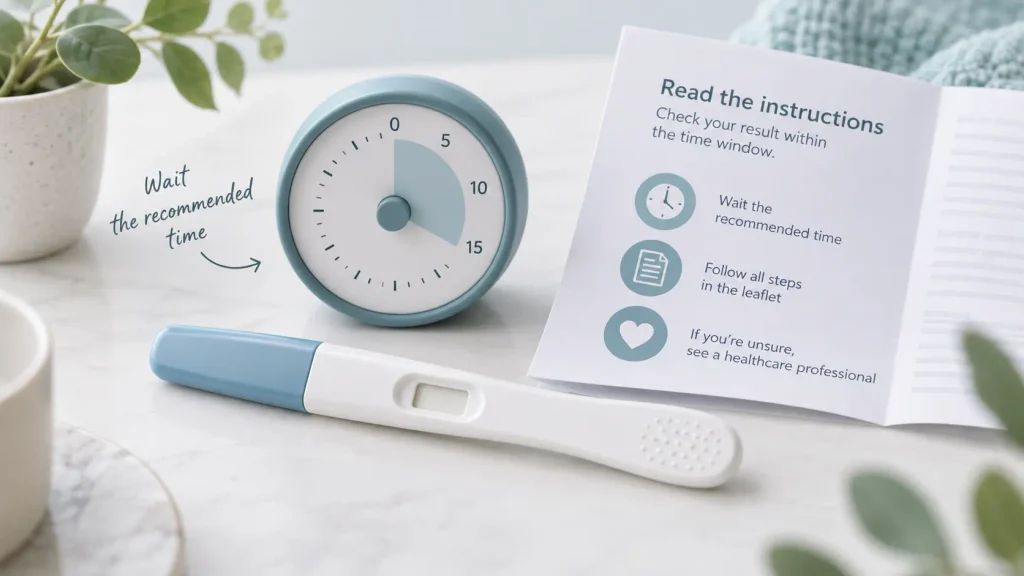
If your tests disagree, it’s worth asking your clinician what to do next. Testing conditions can affect the results, and early pregnancy loss is another possible explanation. Home tests alone can’t tell you which explanation fits. Our guide to biochemical pregnancy and follow-up explains that possibility without treating changing tests as confirmation.
Tell the clinician about a recent pregnancy or fertility medication containing hCG, which can affect interpretation. You don’t need to collect a series of increasingly dark lines before asking for help.
When should you repeat a pregnancy test?
After an early negative, a practical general approach is to wait a few days and test again if pregnancy remains possible. Check the product’s advice, especially if you tested before your period was expected.
There is no mandatory 48-hour home-testing schedule. Guidance varies: some sources suggest several days, while some test instructions suggest waiting longer if your period hasn’t arrived. The reason for repeating is to give a potentially early pregnancy more time to become detectable.
An invalid test is different. Waiting for hormone levels to change won’t make that device valid. Use another test according to its directions, checking the collection method and control indicator.
If a second test is negative but your period still hasn’t started, call your doctor or care team. Repeated negative or mixed results may need a closer look. You don’t have to keep buying tests while wondering what to do.
When you call, it can help to have the test names, dates, results and expected-period date available. Mention symptoms first. If you already have a clinician-directed follow-up plan, follow that plan; general retesting advice doesn’t replace it.
When do symptoms need urgent medical assessment?
Possible pregnancy with concerning symptoms needs assessment even if your home result is negative or unclear. You do not need to have had a positive test before seeking help.
When to seek urgent medical help
Get emergency care now for severe abdominal or pelvic pain, heavy bleeding, fainting or collapse. These symptoms can require immediate assessment. Call 911 in the US if you need emergency assistance.
Seek medical assessment right away for shoulder-tip pain or marked dizziness when pregnancy is possible, particularly with pain or bleeding. If symptoms are severe, you feel faint or you are rapidly becoming unwell, use emergency services.
Get prompt medical advice for other pain or bleeding when you may be pregnant. Don’t wait for another home test or a scheduled appointment if symptoms are worsening.
Pain and bleeding can have different causes; they don’t automatically mean an ectopic pregnancy or miscarriage. The severity and combination of symptoms affect the urgency.
A previous reassuring result also doesn’t cancel out a new concern. Clinical guidance emphasizes reassessment when symptoms change. Once immediate care needs are addressed, our guide to ectopic pregnancy and urgent symptoms explains the assessment in more detail.
What pregnancy tests cannot tell you
A home test detects hormone. By itself, it cannot establish:
- Where a pregnancy is located.
- Whether it is developing normally.
- Why you have pain or bleeding.
- Whether a pregnancy loss has been diagnosed or its follow-up is complete.
Even blood hCG measurements cannot determine pregnancy location by themselves. Clinicians may need to consider symptoms, dates, examination, blood testing or ultrasound, depending on the situation.
That is why repeating home tests cannot resolve every uncertainty. A darker line or another positive result cannot establish normal development. A negative result cannot replace a follow-up appointment you were told to attend.
If you’re unsure what happens next, ask your clinician what the result tells you, what is still unclear and whether you need another appointment or test. That gives you a clearer next step when home testing has reached its limits.
What You Need to Know
- Start around your expected or missed period, following the test’s timing instructions. Earlier testing leaves more room for a false negative.
- An early negative may need repeating. An invalid test needs replacing.
- Follow the collection and reading directions. First-morning urine can matter more before the expected period; requirements vary.
- A 10 mIU/mL threshold is lower than 25 mIU/mL, but it doesn’t guarantee detection a fixed number of days earlier.
- Interpret the specified result within the valid window. Line darkness cannot assess pregnancy health.
- Seek care for conflicting results, a persistently absent period or concerning symptoms. Urgent symptoms take priority over retesting.
- Home tests cannot establish pregnancy location, normal development or completion of loss follow-up.
References
- FDA. Pregnancy: Home-use tests.
- NHS. Doing a pregnancy test.
- MedlinePlus. Pregnancy Test.
- Mayo Clinic. Home pregnancy tests: Can you trust the results?.
- Office on Women’s Health. Pregnancy tests.
- Wilcox et al. (2001). Natural Limits of Pregnancy Testing in Relation to the Expected Menstrual Period. JAMA, 286(14), 1759–1761.
- Cole et al. (2005). Sensitivity of over-the-counter pregnancy tests: comparison of utility and marketing messages.
- Sundermann et al. (2026). Home pregnancy test sensitivity by test timing and cycle length with real-world use among pregnancy planners who conceived.
- Clearblue. US Early Digital Pregnancy Test: Professional product information. Manufacturer specification.
- Clearblue. US Early Digital Pregnancy Test: Use instructions.
- First Response. Early Result Pregnancy Test: Performance claims and instructions.
- Clearblue. Rapid Detection Pregnancy Test: Result instructions.
- NHS. Ectopic pregnancy: Symptoms.
- RCOG. Bleeding and/or pain in early pregnancy.
- NICE. NG126: Diagnosis of viable intrauterine pregnancy and of tubal ectopic pregnancy.