


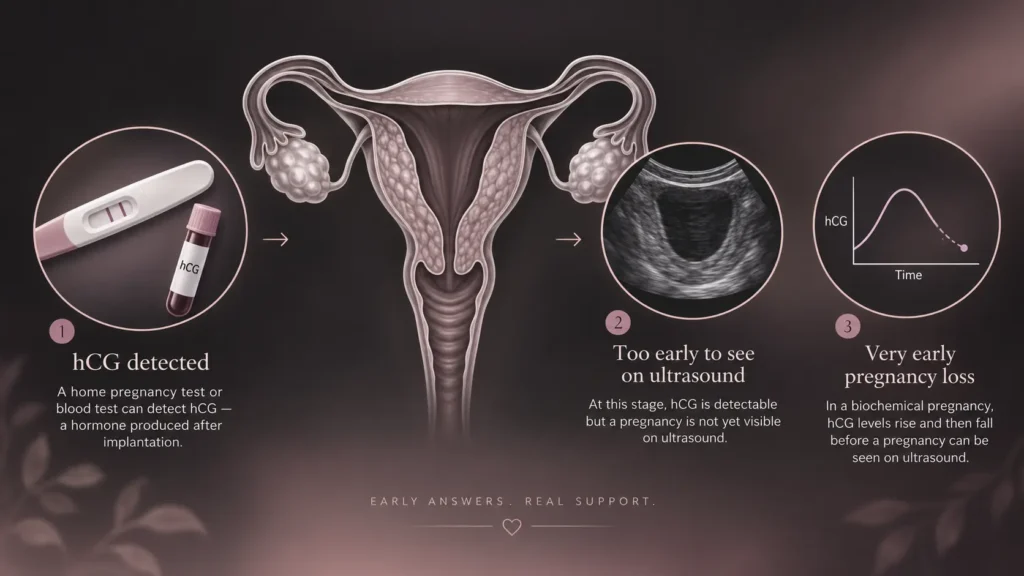
A chemical pregnancy usually refers to a very early loss, before a pregnancy becomes visible on ultrasound. You may be looking for an explanation after a test changed, bleeding began, or a clinician used a term you hadn’t heard before.
I was 43, with three previous C-sections, when I went through an early loss and weeks of uncertainty. Waiting for answers was difficult in its own right. My age and previous births were part of what I worried about, without giving me an explanation for what happened.
If you’re bleeding or in pain now, read the medical-attention section below.
What is a biochemical or chemical pregnancy?
The ICMART glossary defines biochemical pregnancy as a pregnancy diagnosed only by detecting beta-hCG in blood or urine. Patient information often uses chemical pregnancy and biochemical pregnancy for a very early loss, before a pregnancy becomes visible on ultrasound. This article focuses on that early-loss meaning.
A positive pregnancy test alone does not mean a loss has occurred. Nor does an early scan showing no pregnancy settle the question: it may be too soon to see a pregnancy, a loss may have happened, or the pregnancy may be ectopic. Further assessment may be needed.
hCG results contribute to that assessment, but they cannot establish pregnancy location by themselves. Our guide to hCG levels in early pregnancy explains the limits of individual results and trends.
The terminology reflects detection through the pregnancy hormone hCG, rather than seeing a pregnancy on a scan. It doesn’t tell you how much the pregnancy mattered to the person experiencing it.
What can a chemical pregnancy look like?
Possible signs include a positive pregnancy test followed later by a negative one, bleeding that resembles a period, and mild cramping. Some people notice very little. Bleeding may sometimes be heavier than their usual period.
These findings alone do not confirm a biochemical loss or establish where the pregnancy developed. Bleeding and cramping can have other explanations, including in a continuing pregnancy.
Contact your care team about bleeding, pain or changing test results. Tell them about the positive test, any later result, and what you’ve noticed. You don’t need to know what it means before asking for help.
When bleeding or pain needs medical attention
Call emergency services (911 in the U.S.) for sudden, severe abdominal or pelvic pain, fainting or collapse, or heavy bleeding that soaks a pad soon after you put it on. Bleeding with shoulder pain or feeling faint or dizzy also needs emergency help. Severe pain or collapse alone is enough to act.
Get medical advice urgently for bleeding or pain in early pregnancy. Shoulder-tip pain, feeling faint or dizzy, or feeling acutely unwell needs assessment right away, even without bleeding. Contact your pregnancy care team or an urgent medical service.
New or worsening symptoms matter even if previous appointments or hCG results seemed reassuring. Don’t wait for another scheduled test or appointment before seeking help.
When pregnancy location remains uncertain, ectopic pregnancy still needs consideration. Read more about ectopic pregnancy symptoms and diagnosis once any immediate need for care has been addressed.
Why can it happen?
Chromosomal abnormalities are a common cause of early miscarriage overall. Chromosomes carry genetic information; having an abnormal number can prevent a pregnancy from developing normally. That broad explanation does not establish the cause of any one biochemical loss.
The reason for an individual loss may remain unknown.
It is easy to look back through the days before the bleeding and search for something you could have done differently. Everyday activities are not a reason to blame yourself: exercise and sex do not cause early miscarriage, and RCOG reports no evidence that stress causes it.
If you’re worried about a particular health condition or exposure, bring that concern to your clinician. You can ask: “Is there anything in my history that changes what you recommend?” You don’t have to turn uncertainty into a reason to blame yourself.
What happens afterward, and what follow-up may you need?
Follow-up depends on your symptoms and what still needs to be clarified. Your team may use repeat hCG blood tests, ultrasound, or both to assess what is happening. An inconclusive early scan is not an all-clear, and the same follow-up plan will not suit everyone.
After a loss, pregnancy tests may become negative as hCG falls. Follow the instructions your team gives you about testing and results, rather than deciding from a home test alone that monitoring is complete.
My episode began with slight spotting. I then had repeated blood tests over roughly a month and six ultrasounds. Another appointment didn’t necessarily bring a clear answer. The waiting was exhausting, and I hadn’t expected how physically wearing the repeated testing would feel.
During one appointment, blood barely flowed from my left arm. The nurse adjusted, switched arms, and testing continued. I remember that small, practical difficulty as part of the burden of those weeks. I wanted the uncertainty to end.
Those are details of my experience, rather than a schedule another person should expect. Your care team should explain what your own follow-up is checking and how they will decide it is complete.
Before you leave an appointment, you might ask:
- What still needs to be checked?
- Who will explain the results and confirm that follow-up is complete?
- Who should I contact if symptoms change, including outside office hours?
Write down the answers if that makes them easier to keep track of. Having another appointment booked should never leave you feeling that you must wait silently until then. New or worsening symptoms need reassessment, regardless of earlier results.
Do you need more tests after one early loss?
One early loss does not automatically call for a broad investigation into causes. Following up this pregnancy and investigating repeated losses or fertility concerns are different questions. General early-miscarriage guidance does not provide one testing rule for every biochemical loss.
Tell your clinician about previous losses, difficulty conceiving, known conditions, your age and current concerns. Together, these help guide whether further evaluation makes sense for you. Even if no broader investigation is recommended, follow-up for this episode may still be needed.
For any proposed test, ask: “What would this test help explain or change?” If no further investigation is recommended, ask what would prompt the team to reconsider.
When can you try again?
The timing depends on the current episode, any treatment and how you feel. First, complete the assessment your team says is needed and discuss ongoing symptoms. General NHS advice after miscarriage is to wait until symptoms have gone and you feel ready to try.
Any treatment-specific restriction takes priority over general advice about early loss. If you received treatment, ask how it affects timing; recommendations after ectopic treatment, for example, can differ.
Waiting for a period may make a later pregnancy easier to date. That is a practical reason, not a universal requirement for the uterus to “reset” for one cycle. Ask what a suggested wait is intended to achieve in your case.
At 43, I was aware of time. I wanted the monitoring to be over so I could think about trying again, while also wondering what another pregnancy would mean for my family after three surgical births. Those questions made timing feel personal.
Your decision may carry different concerns. Being medically able to try doesn’t create an obligation to start immediately. Wanting to try again also doesn’t mean you have failed to take the loss seriously.
Why can such an early loss hurt so much?
A pregnancy can matter before there is anything to see on a scan. A positive test may already have changed how you picture the coming months or your family. Losing that possibility can hurt, even when few people knew it existed.
For me, the uncertainty stretched the experience out. I kept waiting for the next result to make things clearer. There was hope between appointments, followed by more uncertainty when another scan didn’t give me an answer. I was also asking whether my age or previous C-sections explained what was happening, and whether this was the end of having another child. Those were the questions I carried, not medical conclusions.
Thinking about another pregnancy meant thinking about my existing family, my surgical history and another recovery. All of that was present during the waiting. The pregnancy was early, but the questions it raised in my life were already substantial.
You may recognize some of that, or your response may be quite different. Sadness, mixed feelings or a less intense reaction don’t need to be ranked against someone else’s experience. There is no required level of grief.
You can choose whom to tell and how much to explain. If someone wants to help, a specific request may be easier than a broad conversation: company for an appointment, help with dinner, or listening without offering advice about the next pregnancy. These are options, not tasks you need to complete to recover.
If coping feels difficult, ask your clinician about counseling or pregnancy-loss support. You don’t have to wait until your distress feels severe enough to justify asking.
You can ask someone to take this loss seriously without asking them to solve it.
What You Need to Know
- In this article, chemical pregnancy refers to very early loss before a pregnancy becomes visible on ultrasound; the technical term biochemical pregnancy describes hCG-only detection.
- Test changes, bleeding and cramps cannot establish loss or location by themselves.
- Follow the plan for your episode, and seek help when symptoms change.
- A general explanation for early miscarriage may not reveal why your loss happened.
- Trying again involves medical circumstances, any treatment restrictions and emotional readiness.
- The timing of a loss doesn’t determine its meaning.
For your next conversation with your care team, start with what remains uncertain and what support you need now.
References
- ICMART. The International Glossary on Infertility and Fertility Care, 2017.
- Tommy’s. Chemical pregnancy.
- RCOG. Bleeding and/or pain in early pregnancy.
- NICE. NG126: Diagnosis of viable intrauterine pregnancy and of tubal ectopic pregnancy.
- NHS. Miscarriage.
- NHS. Ectopic pregnancy: Symptoms.
- RCOG. Early miscarriage.
- ACOG. Early Pregnancy Loss: Patient FAQ.
- ACOG. Early Pregnancy Loss: Practice Bulletin.
- RCOG. Ectopic pregnancy.