


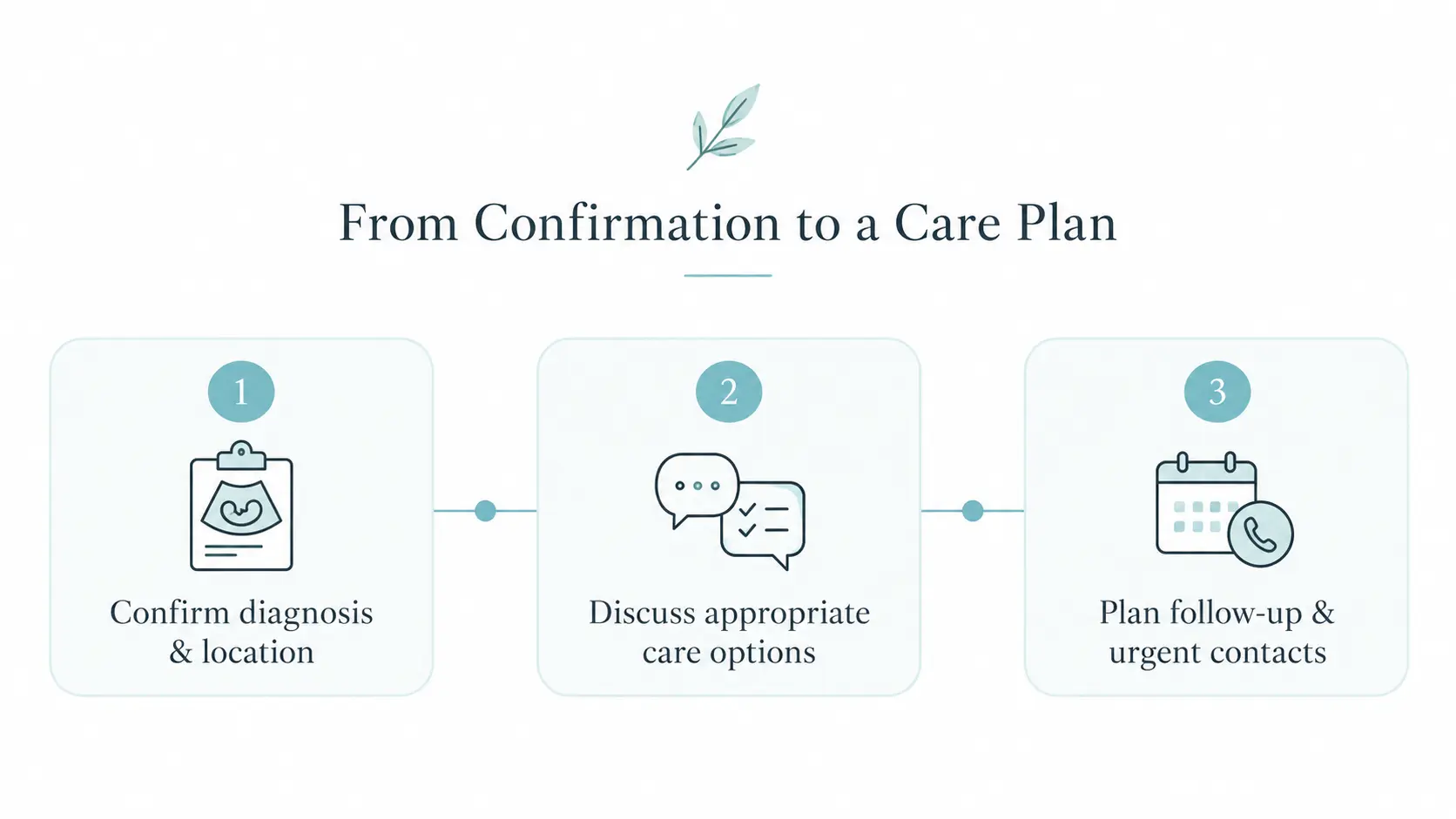
Finding out that a pregnancy may have ended can turn an ordinary appointment into one you remember for years. Before anyone starts talking about medication, a procedure or what happens next, though, there is one thing to establish first: what has happened and where the pregnancy is located. Sometimes that takes more than one assessment.
This guide is about confirmed pregnancy loss inside the uterus through 12 weeks 6 days, and the decisions that follow. Once a loss is confirmed, waiting, medication or a procedure may be appropriate, depending on your health, the findings and your preferences. You should leave care knowing what to expect, how completion will be checked and who to contact. Very heavy bleeding, fainting, severe pain or feeling rapidly unwell needs urgent medical help rather than waiting for a scheduled appointment.
What is an early miscarriage?
An early miscarriage means that a pregnancy in the uterus has ended during the first trimester. In this guide, we use the early pregnancy loss definition covering the first 12 weeks 6 days. The location matters because care for a confirmed intrauterine loss is different from care when the pregnancy’s location is still uncertain.
Clinicians may use a few terms to describe what they have found:
- Missed miscarriage: the pregnancy has ended, but pregnancy tissue remains in the uterus. The loss may be discovered on ultrasound.
- Incomplete miscarriage: some pregnancy tissue has passed and some remains.
- Complete miscarriage: the pregnancy tissue has passed; further treatment to empty the uterus may not be needed.
These terms help guide the management discussion, but they are not diagnoses to make from bleeding alone.
A suspected loss is different from a confirmed one. A pregnancy of unknown location means the pregnancy has not yet been located on ultrasound; it is not automatically a miscarriage. An ectopic pregnancy develops outside the uterine cavity and needs a different assessment and care plan.
A biochemical pregnancy is a very early loss before a pregnancy is confirmed on ultrasound. Our guide to biochemical pregnancy and follow-up covers that situation. But if the location is still unresolved, follow-up is needed rather than assuming it was a biochemical loss.
How is an early miscarriage confirmed?
Sometimes the first scan simply cannot give a definite answer. Ultrasound is central to confirming both where a pregnancy is located and whether it is developing. Clinicians look at the scan findings alongside your dates, symptoms and, where useful, blood tests. A transvaginal scan may provide clearer information early in pregnancy.
The criteria for confirming loss are deliberately cautious because an inconclusive scan cannot establish a diagnosis. Some findings can confirm a loss; if it is too early to be certain, you may need a repeat scan or a second opinion. What happens next depends on what was seen and how the scan was performed, so there is not one waiting period for every situation.
Dates calculated from your last period cannot, on their own, establish what should be visible. The same is true of one episode of bleeding or one hCG result: neither can prove a miscarriage. If blood tests are part of your assessment, understanding blood hCG trends can help explain what they can and cannot show.
That happened in my pregnancy before my son Viktor, in March or April 2021. I had already had several ultrasounds and watched the baby moving on the screen. At a later screening appointment, my doctor told me there was no cardiac activity and that I had experienced a missed miscarriage. It was around the end of the first trimester, although I no longer remember the exact week.
There is one more distinction worth keeping clear: passing tissue does not prove an intrauterine miscarriage if the pregnancy was never located. Follow-up still has to establish what happened. Our guide to ectopic pregnancy and urgent symptoms explains that separate concern. If symptoms worsen while you are waiting, the plan changes: you need reassessment.
What management options may you be offered?
Once a loss is confirmed, the next question is whether pregnancy tissue remains and what care is appropriate. If the miscarriage is complete, you may not need medication or a procedure to empty the uterus.
When further management is needed, there are three broad approaches. Your clinical condition, bleeding or infection risks, preferences and available services all matter.
|
Approach |
What it generally involves |
Practical tradeoff |
Follow-up / possibility of further treatment |
|---|---|---|---|
|
Expectant management |
Waiting for pregnancy tissue to pass, with a care plan |
Avoids medication or a procedure initially; timing is less predictable |
Review is needed; medication or a procedure may follow |
|
Medication management |
Prescribed medicines help the uterus pass tissue |
Can avoid an initial procedure; bleeding and cramping need planning for |
Completion must be checked; further treatment may be needed |
|
Procedural / surgical management |
A procedure removes tissue from the uterus |
More predictable timing; involves procedural and anaesthetic considerations |
Follow the discharge plan; further treatment is sometimes needed |
These are choices to discuss, not steps everyone must go through in order. Heavy bleeding or infection may make prompt treatment necessary. If several approaches are clinically suitable, ask how they fit your circumstances: managing at home, access to help, travel to hospital and how comfortable you feel with uncertain timing.
You can also ask what would lead the team to change the plan. Choosing an initial approach does not mean you have to continue it regardless of new findings or how you are managing.
What happens with expectant management?
Expectant management means waiting for the pregnancy tissue to pass while having access to advice, pain relief and follow-up. That should come with a clear plan for what to do if bleeding doesn’t begin, symptoms continue or you become unwell.
In UK guidance, NICE recommends an initial 7–14 days of expectant management for confirmed miscarriage when appropriate. It also identifies reasons to explore other options, including increased bleeding risk, infection or circumstances that make waiting unsuitable. This is a UK care pathway, not a worldwide requirement to wait before discussing medication or a procedure.
The timing can be harder to predict. Bleeding and cramping may start during the waiting period, and you may pass pregnancy tissue. Ask what pain relief is suitable for you and what level of bleeding should prompt a call or emergency assessment. Written instructions can be useful when you are trying to remember everything later at home.
If bleeding has not started, or pain and bleeding persist or increase, the team may arrange another scan and discuss continued waiting, medication or a procedure. Needing a different approach is part of the management discussion.
The practical arrangements matter too. Can you reach the care team outside office hours? Is someone available if you need help? What happens if the planned review falls on a weekend? Those questions turn “wait and see” into a supported plan with a clear next step.
What happens with medication management?
Medication management uses prescribed medicines to help the uterus pass pregnancy tissue. It may be offered when waiting is not acceptable or suitable, or when you would prefer to try medication rather than an initial procedure.
The prescription can depend on the type of miscarriage. In NICE’s UK medical-management guidance, missed miscarriage is treated with mifepristone followed by misoprostol, while incomplete miscarriage is treated with misoprostol without mifepristone. Your care team should explain the regimen being offered and why it fits your findings.
Bleeding and cramping are part of the expected process, and nausea, vomiting or diarrhoea can occur. You should be offered a pain-relief plan and, where needed, medicine for sickness. Ask who to contact if symptoms are difficult to manage, if bleeding does not start within the timeframe you were given, or if you are unsure whether the process has completed.
Medication can avoid an initial procedure, but it does not guarantee that no further treatment will be needed. The follow-up plan is part of the treatment, even if tissue has passed and the bleeding has eased.
After my diagnosis, I went to hospital and was given medication vaginally. I don’t remember its name. Bleeding and uterine contractions followed, and I passed the pregnancy tissue, which was sent for histopathological examination. That was the care plan used in my case. Other people may be offered a different approach depending on their diagnosis, health and local practice.
What happens with procedural or surgical management?
Procedural management removes pregnancy tissue from the uterus. Suction methods may be used, and you may hear terms such as D&C, meaning dilation and curettage. It helps to ask which procedure is actually being offered rather than assuming the terms on different leaflets all describe the same technique.
Depending on your situation and local services, care may be available with local anaesthesia in an outpatient setting or general anaesthesia in an operating theatre. The team should explain the setting, pain control and recovery arrangements before treatment where circumstances allow.
A procedure may suit someone who prefers more predictable timing, or it may be needed after incomplete expectant or medication management. Heavy continuous bleeding or signs of infection can require more urgent intervention. There are procedural and anaesthetic risks to discuss, including bleeding, infection, injury to the uterus and the possibility of further treatment.
In my case, after the medication and tissue passage, I was taken to the operating room and put under general anaesthesia. As I remember it, a suction-type method was used to remove remaining material from my uterus. I don’t remember the formal procedure name. I do remember being told it was not traditional curettage, and my doctor explained that she wanted to minimize trauma to the uterine wall because I had already had two C-sections.
That was how my doctor explained the decision in my case; it isn’t a rule for everyone who has had previous C-sections.
Before a planned procedure, ask what support you will need afterward and when to contact the team. You should still receive follow-up and safety instructions, even when treatment is expected to be completed during that visit.
What follow-up will you need?
The next question is what happens afterward. Follow-up checks whether the miscarriage has completed and whether you need further care. Depending on the management method and your clinical situation, this may involve discussing symptoms, a urine pregnancy test, ultrasound or selected blood tests. Your own plan should say which check is needed, when it should happen and who reviews the result.
For example, NICE’s UK guidance distinguishes two urine-testing pathways:
- After expectant management, when symptoms suggest the miscarriage has completed during the initial observation period, a home urine pregnancy test is advised three weeks after the miscarriage.
- After medication management, a home urine pregnancy test is advised three weeks after treatment, unless worsening symptoms require earlier assessment.
That does not create one universal testing schedule for every procedure or health service. Follow the instructions given for your care, and ask for clarification if the date or starting point is unclear.
A positive result at the planned check needs clinical review. It does not, by itself, diagnose retained pregnancy tissue. The team may need to assess for remaining tissue or another explanation. A negative test does not override heavy bleeding, pelvic pain or fever; those symptoms still need assessment.
If symptoms persist, ask whether your original plan needs to change rather than simply repeating home tests without a review. Knowing who receives your result can prevent an avoidable gap: are you expected to call, send a message or attend an appointment?
You may also hear about Rh(D) immune globulin, often called anti-D. Whether it is offered depends on your blood group, gestational age and local guidance. In NICE’s current UK guidance, it is not offered for miscarriage through 11 weeks 6 days. RhD-negative people having medical or surgical management at 12 weeks 0 days to 12 weeks 6 days should be offered it. Ask whether the guidance used by your service means anti-D applies to you.
When should you seek urgent medical help?
Seek emergency medical help now for very heavy bleeding, severe abdominal or pelvic pain, or feeling faint, dizzy or seriously unwell. Do not wait for a planned scan, pregnancy test or follow-up visit. These are reasons for urgent assessment during a miscarriage.
Fever, foul-smelling discharge or worsening pain need prompt medical assessment, as they can be signs of infection. Contact your care team urgently; if you feel severely unwell, seek emergency care.
Shoulder-tip pain or one-sided abdominal pain with faintness also needs urgent assessment, especially if the pregnancy’s location was never securely established. These can occur with an ectopic pregnancy.
You do not have to reach a particular pad count before asking for help. How you feel, the severity of pain and whether symptoms are worsening matter. A previous reassuring assessment or a negative pregnancy test should not delay care for new concerning symptoms.
What should you ask before leaving your appointment?
A useful plan answers more than which treatment you are having. It also tells you what happens if the expected course changes. You can write these questions down or ask for the answers in your discharge information:
- Is the diagnosis confirmed, and was the pregnancy located inside the uterus? If there is uncertainty, what assessment comes next?
- Which options are suitable for me, and why? Ask about both medical considerations and your preferences.
- What bleeding and pain should I expect? Which pain relief has been recommended, and when should symptoms prompt a call?
- How will completion be checked? Clarify the date, the test or appointment, and who follows up the result.
- Who can I contact, including overnight or at weekends? Keep the number with your care instructions.
- Does local Rh(D)/anti-D guidance apply to me?
If practical help or emotional support would be useful, say so. You can ask for someone to hear the plan with you, or for information you can read later. You do not need to describe a particular emotional response to deserve clear explanations and support.
What You Need to Know
- Confirmation comes first. One symptom, one hCG result or an inconclusive scan cannot automatically establish an intrauterine miscarriage.
- There are three broad management approaches: expectant care, medication and a procedure. They are not a mandatory sequence.
- The choice depends on your situation. Clinical findings, safety, preferences and available care all matter.
- Leave with a follow-up plan. Know how completion will be checked and what a persistent positive test or continuing symptoms should prompt.
- Get help sooner for concerning symptoms. Very heavy bleeding, fainting, severe pain or feeling rapidly unwell should not wait for routine follow-up.
References
- ACOG: Early Pregnancy Loss — Practice Bulletin.
- NICE NG126: Diagnosis of viable intrauterine pregnancy and of tubal ectopic pregnancy.
- NICE NG126: Management of miscarriage.
- NICE NG126: Anti-D immunoglobulin prophylaxis.
- RCOG: Early miscarriage.
- NHS: Miscarriage.
- NHS: Ectopic pregnancy — Symptoms.
- UCLH: Early miscarriage.